 HISP Rwanda
What is PBF?
Introduction & Background
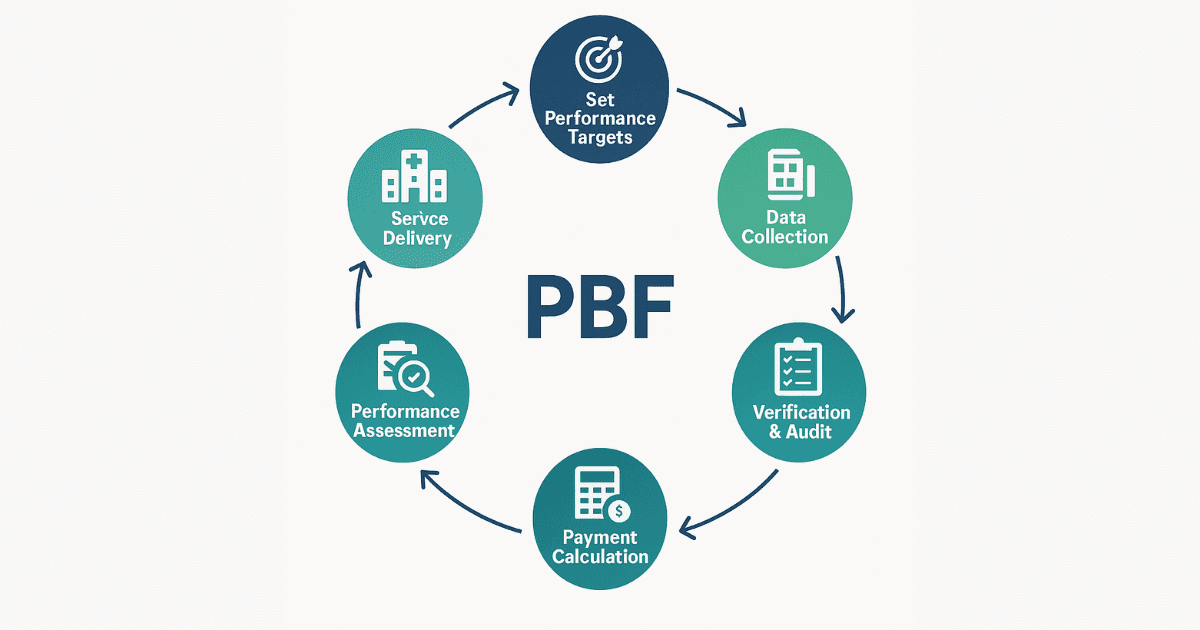
Performance-Based Financing (PBF), also sometimes referred to as “results-based financing” or “pay-for-performance,” is a health (and sometimes social sector) financing reform approach in which payments to service providers (e.g. health facilities, clinics, health workers) are contingent upon achieving predefined performance targets (in terms of quantity, quality, or other agreed indicators). (World Health Organization)
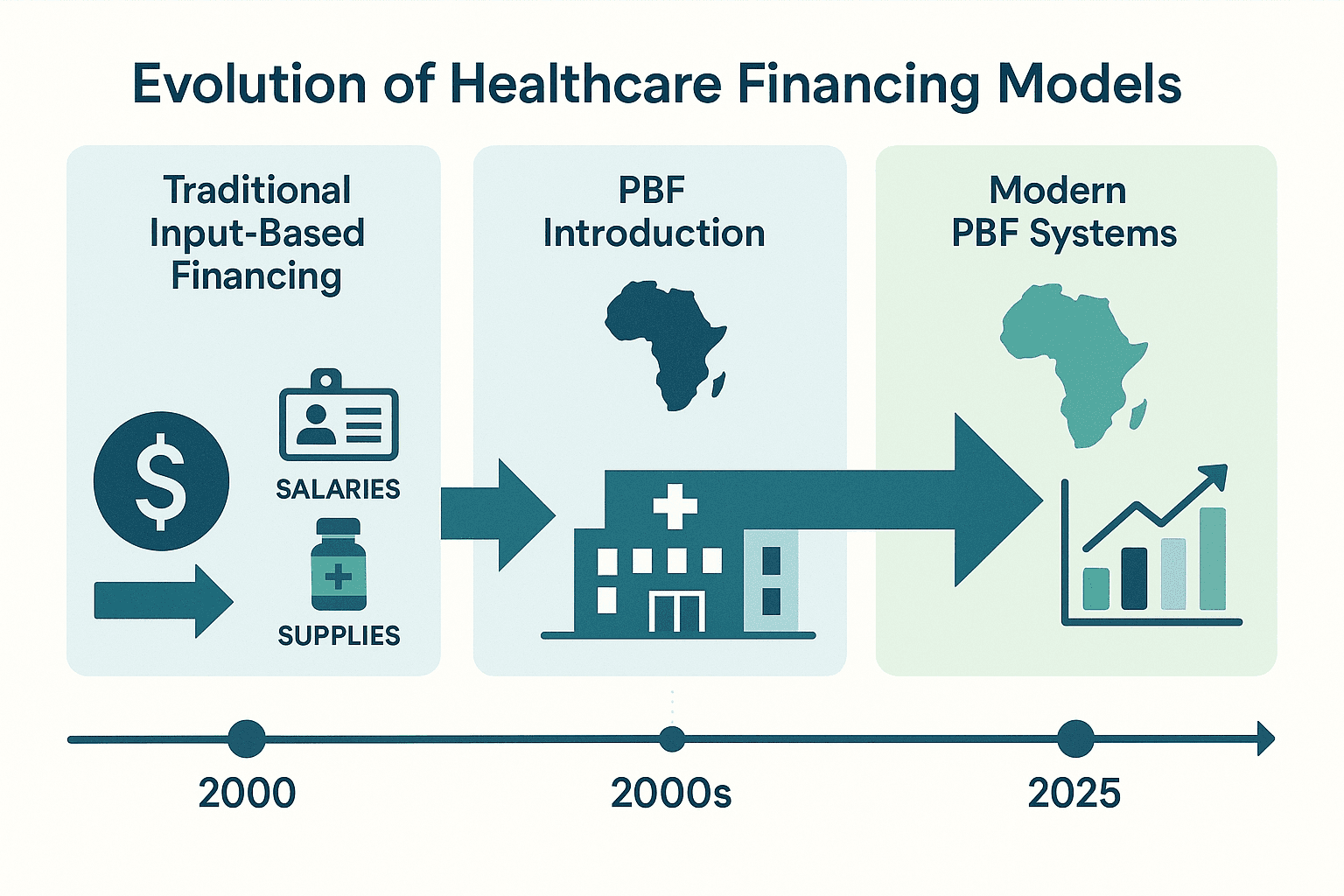
The concept gained particular traction starting in the early-to-mid 2000s, especially in low- and middle-income countries (LMICs), as governments and development partners sought ways to improve efficiency, accountability, and service quality in health systems. (PMC)
In many contexts, PBF is seen as a tool for reforming more traditional input-based budgeting (where funds are tied to inputs like staff salaries, supplies, and operating costs) into a more outcome- or output-oriented model. (PMC)
Some countries—especially in sub-Saharan Africa—have adopted PBF for their health systems: for example, Rwanda famously scaled PBF across its health sector. (The Lancet)
While PBF has been applied primarily in the health sector, the approach can also (in theory) be adapted to other sectors (e.g. education or public services) under the broader umbrella of results-based financing. (SINA Health)
The evolution from traditional input-based financing to performance-based models represents a significant shift in how healthcare systems are funded and managed:
Purpose & Use Cases
Purpose / Rationale
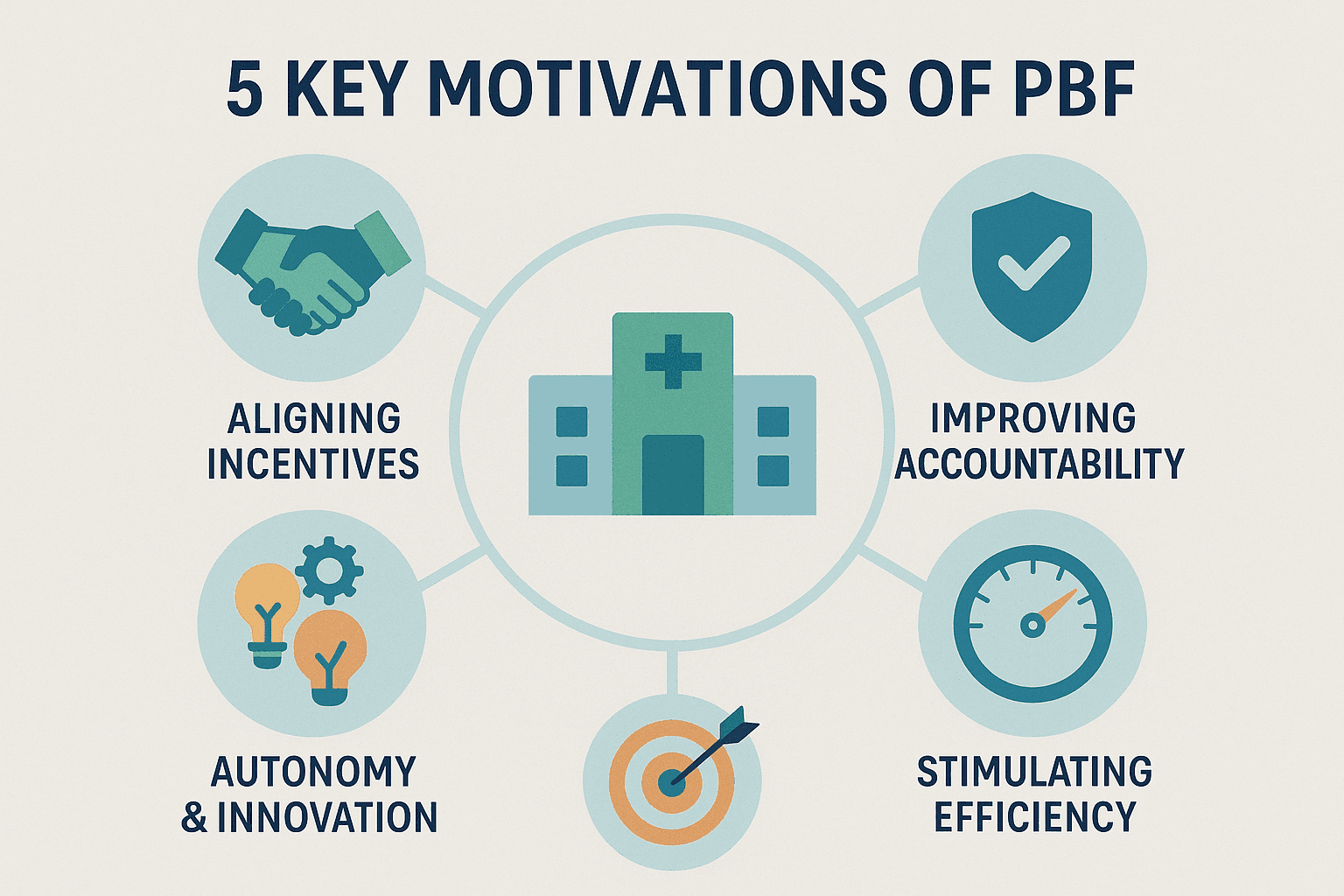
The main motivations behind PBF include:
- Aligning incentives: Encourage service providers to deliver more and better-quality services by linking payments to performance, rather than simply reimbursing inputs. (PMC)
- Improving accountability: By defining clear performance metrics and verification processes, PBF aims to increase transparency in how funds are used. (Management Sciences for Health)
- Stimulating efficiency: Encourage facilities and workers to optimize their operations to meet targets, reduce wastage, and improve service delivery. (PMC)
- Strengthening autonomy and innovation: Granting facilities flexibility in how they use incentive funds (within rules) to invest in improvements (staff, equipment, supplies) can foster innovation. (BioMed Central)
- Focusing on results rather than inputs: To shift the paradigm of public funding from "we've paid for inputs, so services should happen" to "services must meet targets to trigger payment." (World Bank)
The interconnected nature of these motivations creates a comprehensive framework for healthcare improvement:
Use Cases & Examples
Some common uses of PBF in the health sector include:
- Incentivizing maternal and child health services (antenatal care, skilled birth attendance, postnatal care) (PMC)
- Encouraging outreach to underserved or vulnerable populations (e.g. paying extra to facilities serving remote or poor groups) — sometimes called “equity instruments” in PBF schemes. (PMC)
- Improving quality measures (e.g. facility readiness, availability of supplies, clinical standards) in addition to service volume (PMC)
- Reducing user fees or informal charges in targeted services (so as to improve access) while compensating providers via incentive payments (JOGH)
- As an instrument within broader health system reforms aiming to strengthen strategic purchasing and provider payment mechanisms (World Bank)
It is important to emphasize that PBF is rarely a stand-alone “magic bullet”; successful deployment often involves complementary systems (monitoring, verification, capacity building, stakeholder engagement). (PMC)
Key Components & Features
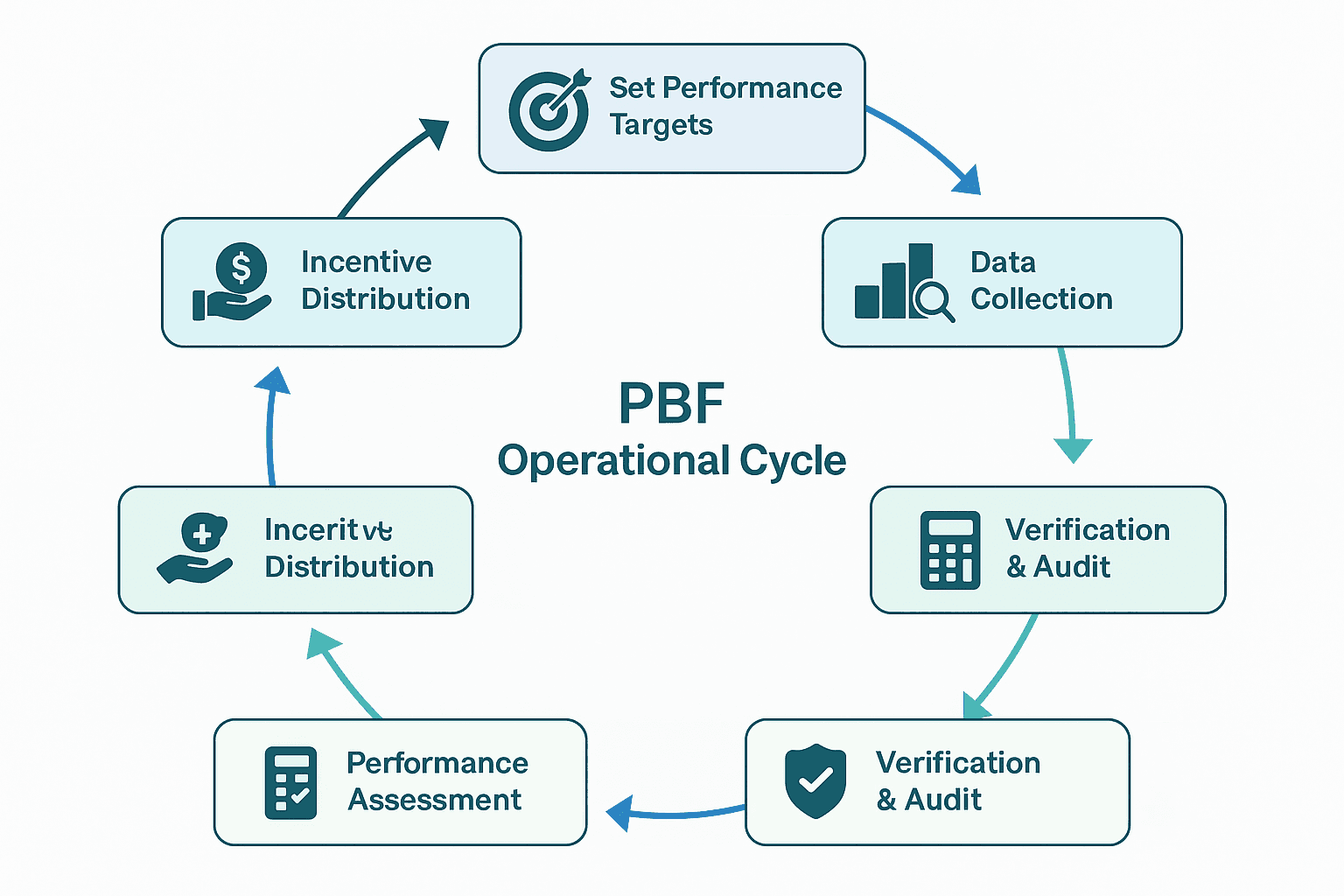
To make PBF operational, many schemes incorporate the following core elements. The operational cycle below illustrates how these components work together in practice:
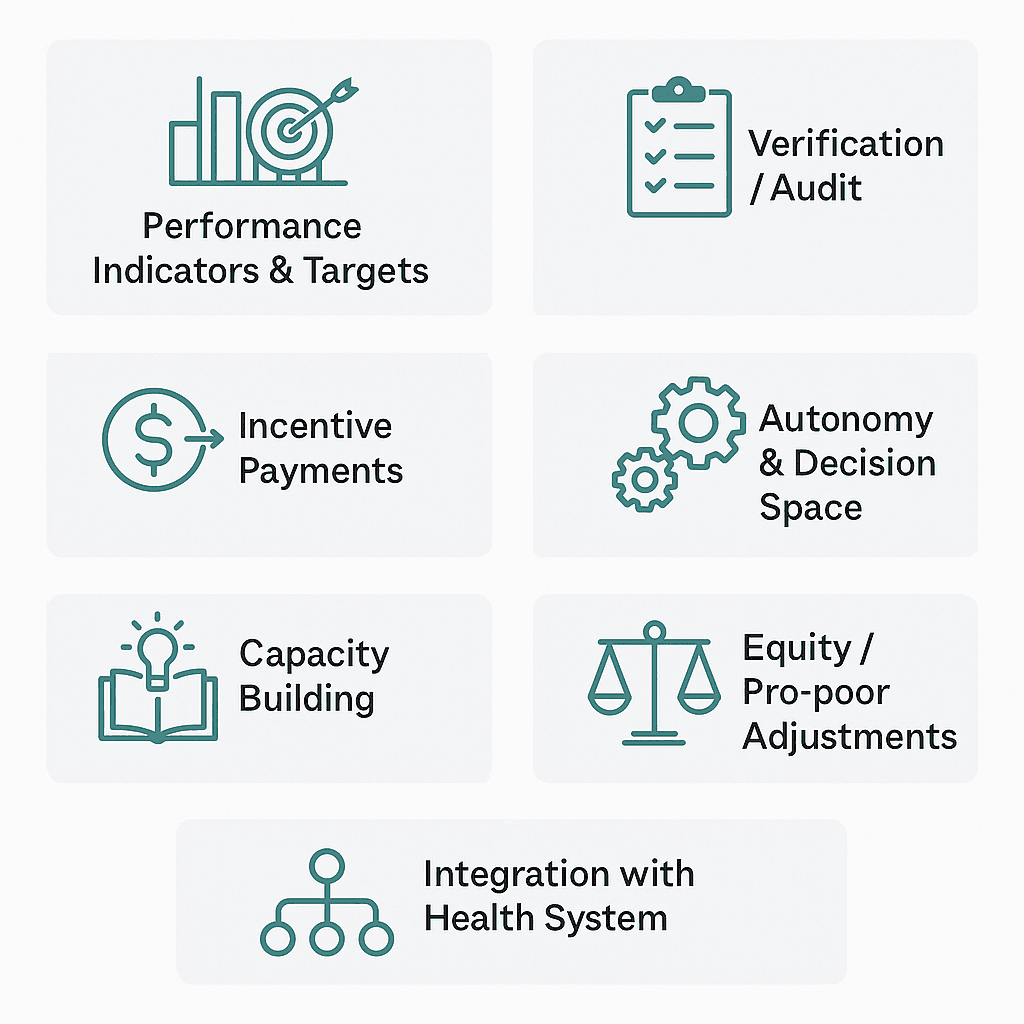
Core Elements
- Performance Indicators & Targets: Clear, measurable outputs or quality metrics agreed between payer and providers (e.g. number of institutional deliveries, proportion of patients receiving a defined standard of care) (PMC)
- Verification / Audit: Independent verification of reported performance (data audits, spot checks, recounted service records) to ensure credibility and limit gaming or inflation of numbers (PMC)
- Incentive Payments: Financial bonuses or payments directed to facilities or health workers, conditional on results, often adjusted for quality or equity factors (World Health Organization)
- Autonomy & Decision Space: Facilities are granted flexibility in how to use incentive funds (within defined rules) — e.g. purchasing supplies, hiring contract staff, small improvements (Management Sciences for Health)
- Capacity Building: Training, coaching, and technical support to ensure providers can respond to incentives, improve data quality, and manage operations effectively (BioMed Central)
- Equity / Pro-poor Adjustments: Some schemes include higher weights or bonus multipliers for services to marginalized or difficult-to-reach populations, or subsidizing fees to reduce financial barriers (PMC)
- Integration with Health System: Aligning PBF with existing budgeting and public financial management (PFM) systems to avoid parallel structures and improve sustainability (World Bank Blogs)
Beyond these basics, PBF schemes often embed monitoring & evaluation frameworks, feedback loops, and iterative adaptation to contextual challenges. (PMC)
Some advanced PBF designs may further incorporate:
- Gradual transition of funding from external donors to government budgets
- More sophisticated quality-adjustment formulas
- Risk adjustment for factors outside provider control
- Phased scaling and piloting before full rollout
Implementation & Technical Considerations (for Our PBF System)
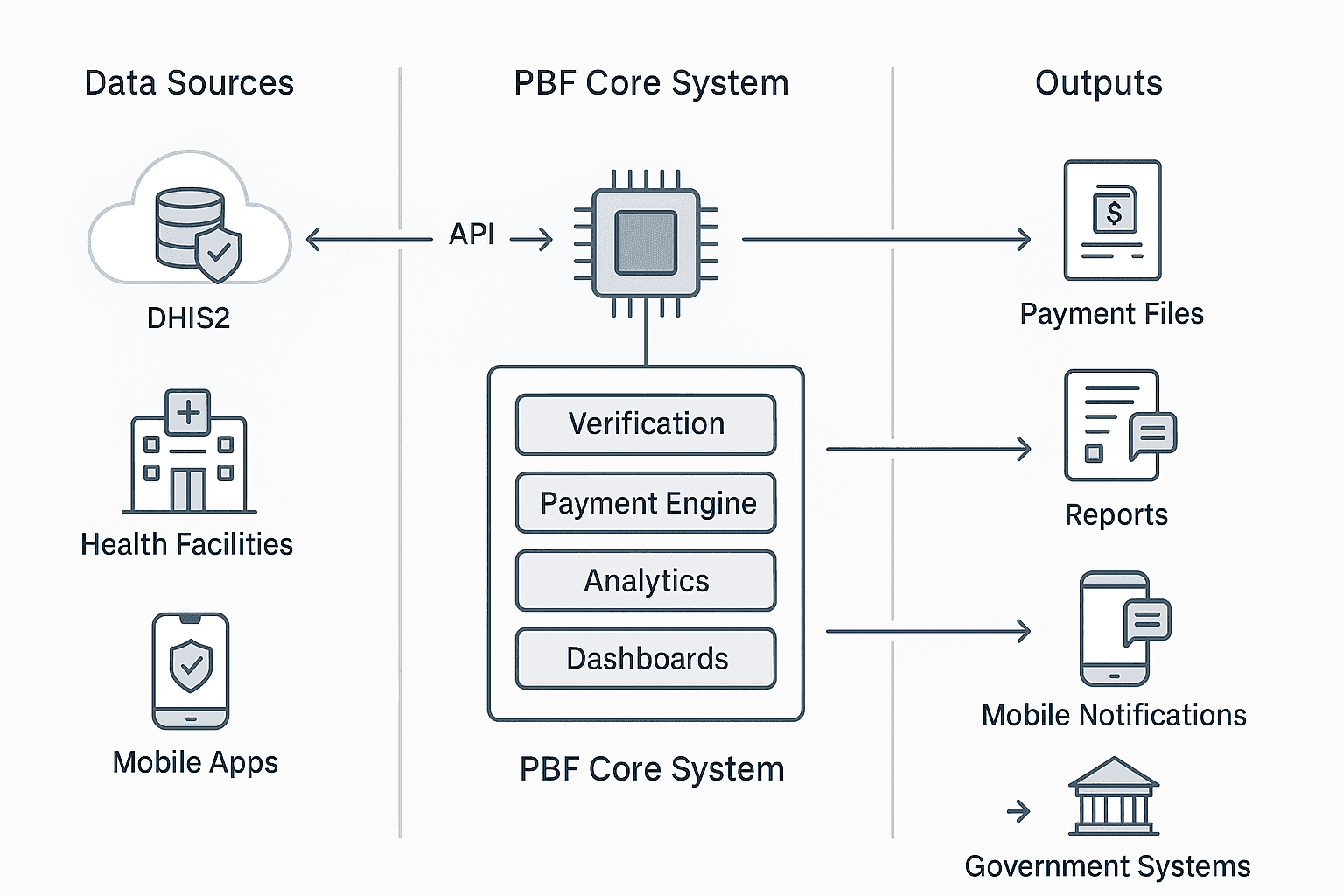
Our PBF system is designed to be easy to install, maintain, and deploy at national scale in any country. The architecture below shows how our system integrates seamlessly with existing health information systems:
Below are the key features and assurances we provide to make adoption smooth, robust, and compelling:
Context & Preconditions
-
Ready for use from day one Our PBF system requires minimal baseline setup. It includes default configuration templates, role-based structures, and data models that can be customized quickly to local context.
-
Seamless DHIS2 integration Our system is built as an external application that integrates effortlessly with DHIS2 via its open, well-documented Web API—without requiring deep changes to the DHIS2 core. (DHIS2 Developer Portal) • It uses the DHIS2 APIs (not direct database writes), so upgrades to DHIS2 won’t break integration. (DHIS2 Developer Portal) • It can synchronize metadata (e.g. organisation units, data elements, categories) and performance data with DHIS2 as needed. • The system is architected so that DHIS2 remains the “single source of truth,” while our PBF application extends DHIS2’s capabilities.
-
Modular & extensible design The system’s modules (incentive engine, verification, dashboards, analytics) are loosely coupled, so you can enable features progressively depending on readiness.
-
Stakeholder readiness & onboarding support We provide built-in role-based dashboards, intuitive user interfaces, and onboarding guides so that health managers, district staff, and technical teams can adopt the system with minimal resistance.
-
Alignment with public financial management (PFM) Our system supports integration with national budgeting systems, audit trails, and accounting modules, ensuring that incentive payments and financial flows can align with existing government PFM frameworks rather than being a parallel system.
-
Anti-gaming & integrity safeguards built in We embed anomaly detection rules, caps/ceilings, and validation logic to limit data inflation, neglect of non-incentivized services, or distorted priorities. These rules can be customized per deployment.
Verification & Data Integrity
-
Real-time data exchange The system ingests performance submissions via API or push mechanisms, with automated reconciliation against DHIS2 records where applicable.
-
Flexible verification workflows The system supports multiple verification modes: algorithmic checks, spot-check audits, community verification, and third-party audits. All verification records, decisions, and justifications are tracked transparently.
-
Feedback & query resolution cycles When discrepancies are found, the system triggers query workflows, appeals, and updates. All steps are versioned and auditable.
-
Comprehensive audit trail Every data change, override, verification decision, and user action is logged with timestamp, user, and metadata. This ensures full traceability and auditability for funders, ministries, or auditors.
Payment & Fund Disbursement
-
Configurable payment logic & schedule Our built-in rules engine lets you define disbursement frequency (monthly, quarterly, etc.), incentive formulas, penalties, quality adjustments, and equity weightings.
-
Banking and fund flow integration The system can generate payment files compatible with banking systems (e.g. XML or CSV), support facility-level accounts, and manage escrow or central fund flows with reconciliation.
-
Approval workflows & checks Multi-level authorization (e.g. regional, central) is supported. The system enforces conditional checks (budget sufficiency, verification completion) before releasing payments.
-
Transparent financial dashboards Stakeholders can view disbursed amounts, pending payments, payment histories, and fund allocations, with drill-down to facility and indicator level.
Capacity Building & Support
-
Embedded training modules & context help The application includes in-app guidance, tooltips, process workflows, and context-sensitive help to reduce the barrier for new users.
-
Performance improvement support We offer analytics-guided suggestions to facilities (based on trends, benchmarks) on how to improve performance and meet targets.
-
Admin configuration & upgrade management System administrators can manage indicators, user roles, version upgrades, and configuration without heavy IT interventions.
Monitoring, Evaluation & Adaptive Learning
-
Dashboarding & analytics built in Interactive dashboards, maps, trend charts, and outlier detection are available for decision-makers at national, regional, and facility levels.
-
Support for evaluation designs We provide export capabilities and integration hooks to plug into external evaluation frameworks (e.g., RCT, baseline–endline studies).
-
Versioning and experiment support Changes (e.g. revised weights, new targets) can be rolled out to subsets of facilities first (i.e. cohorts) to test effects before full rollout.
-
Equity & unintended effect monitoring The system tracks disaggregated data (e.g. by location, socio-economic status) and flags declines in non-incentivized services or underserved populations.
Scalability, Sustainability & Competitive Differentiation
-
Cloud-native, multi-tenant architecture Our system supports deployment across multiple regions or countries from the same platform, with data isolation and configuration per deployment.
-
Governability and handover readiness We design the system to eventually be managed by Ministries or local institutions. We deliver source code, documentation, training, and transition support.
-
Open APIs & extensibility Other systems (e.g. logistics, EMR) can integrate with the PBF application via our APIs. This future-proofs the investment and supports broader health system strengthening.
-
Cost efficiency & ROI The system reduces verification and reconciliation costs, minimizes financial leakage, and streamlines operations—creating strong value in negotiations with clients.
-
Professional support, SLAs & customization We offer support packages, SLA guarantees, customization, and local partner ecosystems to back up deployments and build trust.
Risk Mitigation & Trust Assurance
-
Demonstrated success & case studies We provide real-world deployment metrics—reduced fraud, improved timeliness, accuracy gains—to instill confidence in potential clients.
-
Security, privacy & compliance Data encryption, role-based access control, audit logs, and compliance with applicable data protection regulations are built-in.
-
Offline / fallback modes If connectivity is lost, the system supports offline data capture or reconciliation and syncs automatically when restored.
-
Change management & migration support Tools are provided to migrate existing PBF or pay-for-performance systems and manage transitions in incentive frameworks or targets.
-
Ongoing updates & feature evolution We maintain a roadmap and deliver updates, respond to client feedback, and continuously improve to remain competitive and relevant.
Summary
Performance-Based Financing (PBF) is not just a payment mechanism — it is a reform strategy aiming to reorient health systems toward better performance, accountability, and results. When carefully designed and integrated with system strengthening, it can help align incentives, stimulate innovation, and improve service delivery. But success depends heavily on context, capacity, stakeholder alignment, and continuous adaptation.